Showing posts with label Privacy. Show all posts
Showing posts with label Privacy. Show all posts
Saturday, August 3, 2019
Smoke Detectors Secret Key To All Seeing Eye Spy Technology! (video)
Very good information from a patriot researcher who has uncovered a shocking truth! Every smoke detector sold since 2001 is a spy hub for the government! The researcher says the Snowden documents contained the information about the smoke detectors which is the spy hub for everything! The smoke detector puts out microwaves on special government run frequencies that can penetrate walls far better than normal wi-fi! What does this mean? If this is true and I’m sure it is, then your smoke detector can be accessed by cell phone towers and satellites to give anybody a detailed view of everything going on in your house! All computers, tablets, phones and smart appliances talk to the smoke detector seamlessly which relays all the information to the cell phone towers and satellites!
I always wondered why the CIA director bragged about how your dishwasher would be listening to you when the dishwashers weren’t connected to wifi. Well it turns out smart appliances, (probably everything with a chip) phones, computers, TVs, tablets etc are constantly talking to the smoke detectors which relay all the information back to the government! So even if you have no internet, computers or TVs in the house, your land line phones and anything else with a chip is talking to the smoke detector! I’ll bet even if you had no power to your house and pulled the battery, they could fire a microwave beam at your house from space to remotely power the smoke detector and other devices with chips and hear and see you! This is far worse than we knew! This is how any computer can be hacked even if it’s not connected to the Internet! I think this is a big secret revealed here and it connects the dots. I also like how the researcher tied it in with how ridiculous it is that all this spying is going on to “keep us safe” (THEY would say) but of course they are dumping fluoride in the water to dumb us down and everything else they are doing to us! It’s all a big fraud of course! Get the word out patriots and share the good stories you enjoy at beforeitsnews.com where you find totally uncensored truth!
From Before its News

Friday, March 30, 2018
Microsoft Warns Customers: Watch What You Say When Using Our Products — or Else
If any of us use Skype or any of Microsoft’s products to communicate with others, it’s no surprise that their services track you.
We can now add a new Microsoft policy of punishing account users who use “offensive language” while logged into one of their products or services to the growing list of draconian measures employed by tech companies to police online content.
In a release summarizing the new policy, which will go into effect May 1, Microsoft stated:
In the Code of Conduct section, we’ve clarified that use of offensive language and fraudulent activity is prohibited.
Microsoft stated that they may temporarily suspend or boot offending users permanently from their products. They also reserve the right to search through user content.
The company’s code of conduct was written to crack down on spam, the transmission of malware, child exploitation, and illegal activity. So far, Microsoft has not been explicit about what will constitute offensive language.
Tuesday, July 12, 2016
Pokemon Go is linked to the CIA? Players, beware!
Strange as this may sound, conspiracy researchers online have said that the smartphone game app Pokemon Go is linked to the CIA - if so, then it's no surprise that governments have backdoors to many of the computer and smartphone applications that we are using right now. Crazed Pokemon fans, beware! - FUA
The ‘augmented reality’ mobile game Pokémon Go, which uses the player’s smartphone camera to ‘add’ Pokémon to real-world locations, has ties to the CIA.
The developer of Pokémon Go, Niantic, Inc., was founded by John Hanke, who previously received funding from the CIA’s venture capital firm In-Q-Tel to develop what eventually became Google Earth.
In-Q-Tel was once described as an “independent strategic investment firm that identifies innovative technology solutions to support the missions of the U.S. Intelligence Community.”
It’s easy to see why the CIA would have an interest in the software behind Pokémon Go; the game utilizes the player’s camera and gyroscope to display an image of a Pokémon as though it were in the real world, such as the player’s apartment complex or workplace bathroom.
Read for more - Truth Movement News
The ‘augmented reality’ mobile game Pokémon Go, which uses the player’s smartphone camera to ‘add’ Pokémon to real-world locations, has ties to the CIA.
The developer of Pokémon Go, Niantic, Inc., was founded by John Hanke, who previously received funding from the CIA’s venture capital firm In-Q-Tel to develop what eventually became Google Earth.
In-Q-Tel was once described as an “independent strategic investment firm that identifies innovative technology solutions to support the missions of the U.S. Intelligence Community.”
It’s easy to see why the CIA would have an interest in the software behind Pokémon Go; the game utilizes the player’s camera and gyroscope to display an image of a Pokémon as though it were in the real world, such as the player’s apartment complex or workplace bathroom.
Read for more - Truth Movement News
Thursday, April 28, 2016
Another Frustrating Abuse of Your Rights – But This Time It’s Not By The NSA
Did you know that the FBI had an interest in call phone spying? Seems the NSA wasn't the only agency that has been tracking cell phone calls from people around the world. - FUA
The National Security Administration (NSA) is on my short list of Federal agencies that need to be completely disbanded and disappear. They overstep the Constitution with everything that they do. Unfortunately, however, they are not the only group that seems to think that it’s okay to break the law “to protect us.”
This time the story isn’t about the NSA; it’s about the Federal Bureau of Investigation (FBI). In December 2012, the FBI ordered state and local law enforcement organizations to keep quiet about FBI surveillance of mobile phones. This requirement is still in effect.
Basically, your local police departments are not allowed to tell you that the FBI can both listen to your mobile phone calls and track you based on your mobile phone’s signal.
Read for more - Survival Institute
The National Security Administration (NSA) is on my short list of Federal agencies that need to be completely disbanded and disappear. They overstep the Constitution with everything that they do. Unfortunately, however, they are not the only group that seems to think that it’s okay to break the law “to protect us.”
This time the story isn’t about the NSA; it’s about the Federal Bureau of Investigation (FBI). In December 2012, the FBI ordered state and local law enforcement organizations to keep quiet about FBI surveillance of mobile phones. This requirement is still in effect.
Basically, your local police departments are not allowed to tell you that the FBI can both listen to your mobile phone calls and track you based on your mobile phone’s signal.
Read for more - Survival Institute
Wednesday, December 9, 2015
A bill could give law enforcement access to social media, in the name of terrorism
Video from Newsy - Facebook, Twitter and others could have measures in place to report terrorist activity to law enforcement, thanks to a U.S. bill in the works.
Monday, October 19, 2015
Did a High School Student Hack CIA Director’s Email?
One has to ask, why would a high ranking official in government get access to an AOL account, when many government agencies are using email accounts issued by one of their own, that are much more secure and not so accessible to the outside world? Most organizations have secure email systems in what's call the Intranet (closed/private network). - FUA
WASHINGTON (Reuters) – The FBI and the
Secret Service are investigating reports that CIA Director John
Brennan’s personal email had been hacked, although no classified
information had been accessed, CNN said.
The New York Post reported on Monday that a high school student claimed to have hacked into Brennan’s private AOL account and the Comcast account of Homeland Security Secretary Jeh Johnson.
The hacker told the Post Brennan’s private account contained sensitive files including his 47-page application for top-secret security clearance.
The CIA does not believe any classified information was compromised, according to CNN.
The teenager said he accessed Johnson’s account and also listened to his voicemails, the newspaper reported.
“We are aware of the media report, however as a matter of policy, we do not comment on the secretary’s personal security,” a DHS spokesman said.
According to the Post, the hacker described himself as an American high school student who is not Muslim and was motivated by opposition to U.S. foreign policy and support for Palestine.
Reuters could not immediately verify the reports.
Read more at https://www.trunews.com/did-a-high-school-student-hack-cia-directors-email/#jU6S2ccYjrQuwgpe.99
The New York Post reported on Monday that a high school student claimed to have hacked into Brennan’s private AOL account and the Comcast account of Homeland Security Secretary Jeh Johnson.
The hacker told the Post Brennan’s private account contained sensitive files including his 47-page application for top-secret security clearance.
The CIA does not believe any classified information was compromised, according to CNN.
The teenager said he accessed Johnson’s account and also listened to his voicemails, the newspaper reported.
“We are aware of the media report, however as a matter of policy, we do not comment on the secretary’s personal security,” a DHS spokesman said.
According to the Post, the hacker described himself as an American high school student who is not Muslim and was motivated by opposition to U.S. foreign policy and support for Palestine.
Reuters could not immediately verify the reports.
Read more at https://www.trunews.com/did-a-high-school-student-hack-cia-directors-email/#jU6S2ccYjrQuwgpe.99
Thursday, August 27, 2015
Windows 10 violates your privacy by default, here's how you can protect yourself
Windows 10 appears to have more ways of getting personal information from its users – have you adjusted your privacy settings after you installed it? - FUA
Since the July 29 release of Windows 10, the tech world has been talking about the latest OS update from Microsoft. A mere 24 hours after its release, more than 14 million users had downloaded Windows 10.
The quick ramp up was due, in part, to Microsoft releasing the update as a free download for existing Windows users. Windows 10 also came with a new service model as Windows will be releasing service packs every few months to users.
The model itself got some backlash, especially from organizations that don't want to upgrade their system that frequently. More recently, though, some criticism has arisen over privacy concerns brought on by the new OS.
The first issue is that Windows 10 automatically assigns an advertising ID to each user on a device tied to the email address that's on file. Using that ID, the company can tailor ads for web-browsing and using certain applications.
The next concern is that much of users' personal data is synced with Microsoft's servers. Some of this information, like your Wi-Fi password, can then be encrypted and shared with your contacts, using a feature called Wi-Fi sense. Although, some have argued that this isn't a security risk, because the user must choose to share the network.
Additionally, Microsoft's personal assistant, Cortana, must collect data as well to provide the kind of service it does, but it is likely not better or worse than its Apple and Google contemporaries.
One of the biggest worries, though, is Microsoft's policy on disclosing or sharing your personal information. The following is an excerpt from the privacy policy:
"We will access, disclose and preserve personal data, including your content (such as the content of your emails, other private communications or files in private folders), when we have a good faith belief that doing so is necessary to protect our customers or enforce the terms governing the use of the services."
The problem is that many users want personalized services, but it's difficult to draw the line at what data should be collected. Forrester's Tyler Shields said that instead of making these features default, Microsoft could have allowed users to opt-in later if they wanted to enable them.
"This is more of a privacy-friendly stance that may have been palatable to the general public," Shields said. "However, Microsoft would have had less adoption to its value added services had it made them opt-in, thus lessening the potential success of the Windows 10 launch."
So, how do you protect yourself from these issues? Here are some steps you can take to opt-on or disable some of the problematic features.
The first thing to note is that, if you haven't yet installed Windows 10 but you plan on doing so, make sure you that you do a custom install so you'll be able to pick and choose what is enabled at the onset. But, if you installed Windows 10 using Express settings, you can still disable some of the default privacy settings.
From the start button, click "Settings" and then click "Privacy" and click the "General" tab on the left sidebar. Under that tab you'll see a few sliders where you can toggle certain features on or off.
The top toggle button is the most important as it disables the advertising ID for each user. But, if you want to cover your bases, you should go ahead disable the rest of the options as well.
Saturday, June 27, 2015
Google Chrome taps into your microphone
Now we know that Google Chrome has a backdoor setting that turns on your microphone, anyone plans to uninstall it? - FUA
Yesterday, news broke that Google has been stealth downloading audio listeners onto every computer that runs Chrome, and transmits audio data back to Google. Effectively, this means that Google had taken itself the right to listen to every conversation in every room that runs Chrome somewhere, without any kind of consent from the people eavesdropped on. In official statements, Google shrugged off the practice with what amounts to “we can do that”.
It looked like just another bug report. "When I start Chromium, it downloads something." Followed by strange status information that notably included the lines "Microphone: Yes" and "Audio Capture Allowed: Yes".
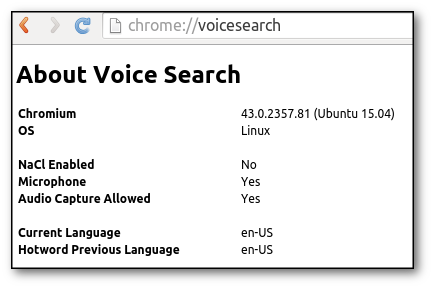
Without consent, Google’s code had downloaded a black box of code that – according to itself – had turned on the microphone and was actively listening to your room.
A brief explanation of the Open-source / Free-software philosophy is needed here. When you’re installing a version of GNU/Linux like Debian or Ubuntu onto a fresh computer, thousands of really smart people have analyzed every line of human-readable source code before that operating system was built into computer-executable binary code, to make it common and open knowledge what the machine actually does instead of trusting corporate statements on what it’s supposed to be doing. Therefore, you don’t install black boxes onto a Debian or Ubuntu system; you use software repositories that have gone through this source-code audit-then-build process. Maintainers of operating systems like Debian and Ubuntu use many so-called “upstreams” of source code to build the final product.
Chromium, the open-source version of Google Chrome, had abused its position as trusted upstream to insert lines of source code that bypassed this audit-then-build process, and which downloaded and installed a black box of unverifiable executable code directly onto computers, essentially rendering them compromised. We don’t know and can’t know what this black box does. But we see reports that the microphone has been activated, and that Chromium considers audio capture permitted.
This was supposedly to enable the “Ok, Google” behavior – that when you say certain words, a search function is activated. Certainly a useful feature. Certainly something that enables eavesdropping of every conversation in the entire room, too.
Obviously, your own computer isn’t the one to analyze the actual search command. Google’s servers do. Which means that your computer had been stealth configured to send what was being said in your room to somebody else, to a private company in another country, without your consent or knowledge, an audio transmission triggered by… an unknown and unverifiable set of conditions.
Google had two responses to this. The first was to introduce a practically-undocumented switch to opt out of this behavior, which is not a fix: the default install will still wiretap your room without your consent, unless you opt out, and more importantly, know that you need to opt out, which is nowhere a reasonable requirement. But the second was more of an official statement following technical discussions on Hacker News and other places. That official statement amounted to three parts (paraphrased, of course):
1) Yes, we’re downloading and installing a wiretapping black-box to your computer. But we’re not actually activating it. We did take advantage of our position as trusted upstream to stealth-insert code into open-source software that installed this black box onto millions of computers, but we would never abuse the same trust in the same way to insert code that activates the eavesdropping-blackbox we already downloaded and installed onto your computer without your consent or knowledge. You can look at the code as it looks right now to see that the code doesn’t do this right now.
2) Yes, Chromium is bypassing the entire source code auditing process by downloading a pre-built black box onto people’s computers. But that’s not something we care about, really. We’re concerned with building Google Chrome, the product from Google. As part of that, we provide the source code for others to package if they like. Anybody who uses our code for their own purpose takes responsibility for it. When this happens in a Debian installation, it is not Google Chrome’s behavior, this is Debian Chromium’s behavior. It’s Debian’s responsibility entirely.
3) Yes, we deliberately hid this listening module from the users, but that’s because we consider this behavior to be part of the basic Google Chrome experience. We don’t want to show all modules that we install ourselves.
If you think this is an excusable and responsible statement, raise your hand now.
Now, it should be noted that this was Chromium, the open-source version of Chrome. If somebody downloads the Google product Google Chrome, as in the prepackaged binary, you don’t even get a theoretical choice. You’re already downloading a black box from a vendor. In Google Chrome, this is all included from the start.
This episode highlights the need for hard, not soft, switches to all devices – webcams, microphones – that can be used for surveillance. A software on/off switch for a webcam is no longer enough, a hard shield in front of the lens is required. A software on/off switch for a microphone is no longer enough, a physical switch that breaks its electrical connection is required. That’s how you defend against this in depth.
Of course, people were quick to downplay the alarm. “It only listens when you say ‘Ok, Google’.” (Ok, so how does it know to start listening just before I’m about to say ‘Ok, Google?’) “It’s no big deal.” (A company stealth installs an audio listener that listens to every room in the world it can, and transmits audio data to the mothership when it encounters an unknown, possibly individually tailored, list of keywords – and it’s no big deal!?) “You can opt out. It’s in the Terms of Service.” (No. Just no. This is not something that is the slightest amount of permissible just because it’s hidden in legalese.) “It’s opt-in. It won’t really listen unless you check that box.” (Perhaps. We don’t know, Google just downloaded a black box onto my computer. And it may not be the same black box as was downloaded onto yours. )
Early last decade, privacy activists practically yelled and screamed that the NSA’s taps of various points of the Internet and telecom networks had the technical potential for enormous abuse against privacy. Everybody else dismissed those points as basically tinfoilhattery – until the Snowden files came out, and it was revealed that precisely everybody involved had abused their technical capability for invasion of privacy as far as was possible.
Perhaps it would be wise to not repeat that exact mistake. Nobody, and I really mean nobody, is to be trusted with a technical capability to listen to every room in the world, with listening profiles customizable at the identified-individual level, on the mere basis of “trust us”.
Privacy remains your own responsibility.
Wednesday, June 24, 2015
Tell ICANN: Don't expose WHOIS data
Bad news for top level domain name users everywhere – ICANN threatens to expose the WHOIS data, and take a guess on who’s really behind this? The RIAA, MPAA and others that backed the Stop Online Piracy Act in the past. Will you take action and make sure your domain name registry is protected between you and your domain name provider? Sounds urgent. - FUA
Tell ICANN: "Respect our privacy. Don't expose WHOIS data."
Did you know that your privacy rights are currently under threat? ICANN* – the overseers of the Internet’s domain name system – are considering introducing a rule that would impact all netizens. If you care about your online privacy, this is a big deal.
Save Domain Privacy: Respect our privacy. Don't expose WHOIS data.
Google Secretly Spying On Computer Users Via Microphones
There’s been a discovery that Google has used its Chrome browser to spy on computer users through their microphones, without their knowledge or consent. This shows that while software can be accessed for free or at a cost, there’s something happening in the background that many Internet users do not know about.
Same applies to consumer electronics, you can expect to have chips/backdoors in them that may do the same. - FUA
Almost a decade after Infowars first warned that corporations may be spying on computer users via PC microphones, it has now come to light that secretly installed Google software is doing precisely that.
“The Chromium browser – the open source basis for Google’s Chrome – began remotely installing audio-snooping code that was capable of listening to users,” reports the London Guardian.
The software was designed to work with Chrome’s ‘OK, Google’ hotword detection, which functions in response to voice commands given by the user – but in some cases the software was installed and activated without permission.
“Without consent, Google’s code had downloaded a black box of code that – according to itself – had turned on the microphone and was actively listening to your room,” writes Pirate party founder Rick Falkvinge. “Which means that your computer had been stealth configured to send what was being said in your room to somebody else, to a private company in another country, without your consent or knowledge, an audio transmission triggered by … an unknown and unverifiable set of conditions.”
Google has denied the accusations, asserting that users have to “opt-in” before the software is activated, but developers insist otherwise.
“The default install will still wiretap your room without your consent, unless you opt out, and more importantly, know that you need to opt out, which is nowhere a reasonable requirement,” said Falkvinge.
Friday, June 5, 2015
US lawmaker: Next, we stop the NSA from weakening encryption
Now we’ll see how lawmakers in Congress will handle the NSA’s ability to decrypt data on the Internet and cell phones. Until then, keep on encrypting your personal and private info. - FUA
NEW YORK -- With one surveillance reform package out the door, lawmakers are working the big "what's next."
Hot on the heels of President Barack Obama signing the Freedom Act into law Wednesday, a bipartisan congressional effort is now focusing their efforts on preventing the government from weakening encryption.
An amendment put forward by Rep. Thomas Massie (R-KY, 4th) to a recent appropriations bill passed by overwhelming majority of 383-43 late in the day Wednesday.
Massie, a strong advocate for privacy and civil liberties, explained on the phone Thursday that his eight-line amendment will prevent the NSA, which remains an encryption expert, from working with the National Institute of Standards and Technology (NIST) to weaken or compromise encryption.
US lawmaker: Next, we stop the NSA from weakening encryption | ZDNet
Friday, December 13, 2013
How to protect yourself from FBI webcam spying
RT America tells you here how you can make sure you webcam isn't used for spying by the FBI, or anyone else:
Friday, October 18, 2013
Real name and face on Google's ads?
Coming soon, Google may feature you in their online ads. with your real name and profile picture. In Google's new Terms of Use, it revealed that it may use your Google+ profile name and picture as shared endorsements to family, friends and other users.
Ars Technica - with more info
Ars Technica - with more info
Friday, September 6, 2013
NSA and British intel had interest in decryption
More documents about the NSA revealed that they may have had interest in breaking encryption to gain access to information from the Internet, such as e-mails, medical records and banking info.
GCHQ (British intelligence) also may had interest in decrypting info on the web as well.
Many people use encryption to protect information for a good reason: privacy. Also this is done to deter cyber-criminals who may use sensitive info for their own purposes.
So this may prove that even with encryption, there's not much escape from the NSA, providing they have the effective back-door means to access such encrypted info.
TheGuardian - Revealed: how US and UK spy agencies defeat internet privacy and security
GCHQ (British intelligence) also may had interest in decrypting info on the web as well.
Many people use encryption to protect information for a good reason: privacy. Also this is done to deter cyber-criminals who may use sensitive info for their own purposes.
So this may prove that even with encryption, there's not much escape from the NSA, providing they have the effective back-door means to access such encrypted info.
TheGuardian - Revealed: how US and UK spy agencies defeat internet privacy and security
Thursday, July 4, 2013
People protesting NSA surveillance programs in Washington DC
Thanks to the Associated Press for covering this, now people in Washington are protesting the NSA surveillance programs, the collection of data from cell phones and the Internet.
Tuesday, May 28, 2013
Obama to support Internet wiretapping program
RT America video on FBI's latest attempt to monitor Internet users on chats, emails and more.
Friday, March 29, 2013
How Twitter can get you fired
Russia Today video on how social media sites like Twitter can get people fired from their jobs.
Even digital dirt (info out there about you on the web) may be enough to raise an eyebrow or two from employers, because most of them keep tabs on you on the web, and so will job recruiters.
It serves as a reminder to keep your private stuff private and be mindful on what info you put out on the web.
Even digital dirt (info out there about you on the web) may be enough to raise an eyebrow or two from employers, because most of them keep tabs on you on the web, and so will job recruiters.
It serves as a reminder to keep your private stuff private and be mindful on what info you put out on the web.
Friday, December 28, 2012
More Internet restrictions coming to China
The Chinese regime announced its latest plans for more control over the Internet in the country. The first one is having Net users register their names with ISPs and government-run sites, which is probably been in place before, Then, it legalizes the deletion and interception of posts and data from Net users that may deem “illegal” online, effectively controlling what the Chinese can say and do, and retain data about what a user has posted – which is called data retention.
Such measures like these will allow the Chinese police to identify and snuff out dissidents that are posting info that is frown upon by the Chinese regime, taking the Big Brother internet policing to the next level.
This comes after Internet users in China exposed lower-level officials that may have engaged in government corruption, and wanting extra measures in place to prevent false and anonymous accusations online.
So if you want to expose a corrupt government official, the Chinese regime may not take your word for it without disclosing your real name and info.
Source: Reuters
Such measures like these will allow the Chinese police to identify and snuff out dissidents that are posting info that is frown upon by the Chinese regime, taking the Big Brother internet policing to the next level.
This comes after Internet users in China exposed lower-level officials that may have engaged in government corruption, and wanting extra measures in place to prevent false and anonymous accusations online.
So if you want to expose a corrupt government official, the Chinese regime may not take your word for it without disclosing your real name and info.
Source: Reuters
Saturday, December 22, 2012
UK looking to spy on the unemployed on the net
What could the British government want with the unemployed, other than helping them find work? They’re turning to benefit claimants who submitted their applications online and looking to track them to see if they’re doing their best to find work in the UK.
According to The Telegraph, the unemployed may not qualify for benefits if a job position is not found on the Universal Jobmatch website.
Wednesday, December 12, 2012
Alex Jones: Transit Authorities Admit to Spying on You, Filming restrictions and more
Alex Jones of Infowars.com protesting on government spying and filming restrictions on police and government buildings. Video from the Infowars Nightly News.
Subscribe to:
Posts (Atom)