Pages

Showing posts with label Google. Show all posts

Tuesday, March 24, 2020

Social media censors and algorithmic changes are down, thanks to Q team

Seems that our white hats (our friends at the Pentagon, Q team, et al.) have regain control over Google with most, if not all, censors and algorithmic changes undone.

There is a cyber war of sorts happening at this time between the Earth Alliance and the black hats (Deep state cabal) - this is going to continue for a while longer.

Setting the stage for Disclosure involves regaining control of much of the web infrastructure the black hats have ties to.

Reports on Twitter on this effort:


Majestic 12 confirms the Google censors have become undone.


Lastly, type in "Majestic 12" into Google search.

What do you see?

YouTube has also experienced a similar takeover effect.

My thanks to the white hat Alliance, they are SETTING THE STAGE!

Thursday, March 8, 2018

White House Warns Tech Giants To Stop Censoring (video)

Alex Jones joins Owen Shroyer live via Skype to lay out how President Trump's White House has fired the first shots across the bows of the tech giants: Facebook, Twitter, and especially Google.


Infowars.com: Trump Administration First Shot Across Big Tech Giants’ Bow: Warns Them of Censorship

Brad Parscale’s comment came on the same day as the results of primaries for the Texas senatorial race in November were released. Google and Facebook both have the ability to significantly influence elections. Facebook has previously boosted voter registration and turnout by significant margins, while research on search engine manipulation shows that services like Google Search have the potential to change the preferences of undecided voters by 20 percent or more.

Brad Parscale, current campaign manager for the president’s 2020 re-election bid, previously managed Trump’s digital campaign in 2016. In public interviews, Parscale has argued that social media, not traditional media, was the key to Trump’s victory in 2016, and identified Facebook as particularly critical to the president’s success. His selection suggests that the digital campaigning will be given even greater emphasis in 2020.

More at Infowars.com

Saturday, June 27, 2015

Google Chrome taps into your microphone

Now we know that Google Chrome has a backdoor setting that turns on your microphone, anyone plans to uninstall it? - FUA

Yesterday, news broke that Google has been stealth downloading audio listeners onto every computer that runs Chrome, and transmits audio data back to Google. Effectively, this means that Google had taken itself the right to listen to every conversation in every room that runs Chrome somewhere, without any kind of consent from the people eavesdropped on. In official statements, Google shrugged off the practice with what amounts to “we can do that”.

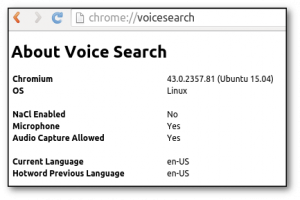
It looked like just another bug report. "When I start Chromium, it downloads something." Followed by strange status information that notably included the lines "Microphone: Yes" and "Audio Capture Allowed: Yes".
chrome-voicesearch

Without consent, Google’s code had downloaded a black box of code that – according to itself – had turned on the microphone and was actively listening to your room.

A brief explanation of the Open-source / Free-software philosophy is needed here. When you’re installing a version of GNU/Linux like Debian or Ubuntu onto a fresh computer, thousands of really smart people have analyzed every line of human-readable source code before that operating system was built into computer-executable binary code, to make it common and open knowledge what the machine actually does instead of trusting corporate statements on what it’s supposed to be doing. Therefore, you don’t install black boxes onto a Debian or Ubuntu system; you use software repositories that have gone through this source-code audit-then-build process. Maintainers of operating systems like Debian and Ubuntu use many so-called “upstreams” of source code to build the final product.

Chromium, the open-source version of Google Chrome, had abused its position as trusted upstream to insert lines of source code that bypassed this audit-then-build process, and which downloaded and installed a black box of unverifiable executable code directly onto computers, essentially rendering them compromised. We don’t know and can’t know what this black box does. But we see reports that the microphone has been activated, and that Chromium considers audio capture permitted.

This was supposedly to enable the “Ok, Google” behavior – that when you say certain words, a search function is activated. Certainly a useful feature. Certainly something that enables eavesdropping of every conversation in the entire room, too.

Obviously, your own computer isn’t the one to analyze the actual search command. Google’s servers do. Which means that your computer had been stealth configured to send what was being said in your room to somebody else, to a private company in another country, without your consent or knowledge, an audio transmission triggered by… an unknown and unverifiable set of conditions.

Google had two responses to this. The first was to introduce a practically-undocumented switch to opt out of this behavior, which is not a fix: the default install will still wiretap your room without your consent, unless you opt out, and more importantly, know that you need to opt out, which is nowhere a reasonable requirement. But the second was more of an official statement following technical discussions on Hacker News and other places. That official statement amounted to three parts (paraphrased, of course):

1) Yes, we’re downloading and installing a wiretapping black-box to your computer. But we’re not actually activating it. We did take advantage of our position as trusted upstream to stealth-insert code into open-source software that installed this black box onto millions of computers, but we would never abuse the same trust in the same way to insert code that activates the eavesdropping-blackbox we already downloaded and installed onto your computer without your consent or knowledge. You can look at the code as it looks right now to see that the code doesn’t do this right now.

2) Yes, Chromium is bypassing the entire source code auditing process by downloading a pre-built black box onto people’s computers. But that’s not something we care about, really. We’re concerned with building Google Chrome, the product from Google. As part of that, we provide the source code for others to package if they like. Anybody who uses our code for their own purpose takes responsibility for it. When this happens in a Debian installation, it is not Google Chrome’s behavior, this is Debian Chromium’s behavior. It’s Debian’s responsibility entirely.

3) Yes, we deliberately hid this listening module from the users, but that’s because we consider this behavior to be part of the basic Google Chrome experience. We don’t want to show all modules that we install ourselves.

If you think this is an excusable and responsible statement, raise your hand now.

Now, it should be noted that this was Chromium, the open-source version of Chrome. If somebody downloads the Google product Google Chrome, as in the prepackaged binary, you don’t even get a theoretical choice. You’re already downloading a black box from a vendor. In Google Chrome, this is all included from the start.

This episode highlights the need for hard, not soft, switches to all devices – webcams, microphones – that can be used for surveillance. A software on/off switch for a webcam is no longer enough, a hard shield in front of the lens is required. A software on/off switch for a microphone is no longer enough, a physical switch that breaks its electrical connection is required. That’s how you defend against this in depth.

Of course, people were quick to downplay the alarm. “It only listens when you say ‘Ok, Google’.” (Ok, so how does it know to start listening just before I’m about to say ‘Ok, Google?’) “It’s no big deal.” (A company stealth installs an audio listener that listens to every room in the world it can, and transmits audio data to the mothership when it encounters an unknown, possibly individually tailored, list of keywords – and it’s no big deal!?) “You can opt out. It’s in the Terms of Service.” (No. Just no. This is not something that is the slightest amount of permissible just because it’s hidden in legalese.) “It’s opt-in. It won’t really listen unless you check that box.” (Perhaps. We don’t know, Google just downloaded a black box onto my computer. And it may not be the same black box as was downloaded onto yours. )

Early last decade, privacy activists practically yelled and screamed that the NSA’s taps of various points of the Internet and telecom networks had the technical potential for enormous abuse against privacy. Everybody else dismissed those points as basically tinfoilhattery – until the Snowden files came out, and it was revealed that precisely everybody involved had abused their technical capability for invasion of privacy as far as was possible.

Perhaps it would be wise to not repeat that exact mistake. Nobody, and I really mean nobody, is to be trusted with a technical capability to listen to every room in the world, with listening profiles customizable at the identified-individual level, on the mere basis of “trust us”.

Privacy remains your own responsibility.

Source Link - Privacy Internet Access

Wednesday, June 24, 2015

Google Secretly Spying On Computer Users Via Microphones

There’s been a discovery that Google has used its Chrome browser to spy on computer users through their microphones, without their knowledge or consent. This shows that while software can be accessed for free or at a cost, there’s something happening in the background that many Internet users do not know about.

Same applies to consumer electronics, you can expect to have chips/backdoors in them that may do the same. - FUA

Almost a decade after Infowars first warned that corporations may be spying on computer users via PC microphones, it has now come to light that secretly installed Google software is doing precisely that.

“The Chromium browser – the open source basis for Google’s Chrome – began remotely installing audio-snooping code that was capable of listening to users,” reports the London Guardian.

The software was designed to work with Chrome’s ‘OK, Google’ hotword detection, which functions in response to voice commands given by the user – but in some cases the software was installed and activated without permission.

“Without consent, Google’s code had downloaded a black box of code that – according to itself – had turned on the microphone and was actively listening to your room,” writes Pirate party founder Rick Falkvinge. “Which means that your computer had been stealth configured to send what was being said in your room to somebody else, to a private company in another country, without your consent or knowledge, an audio transmission triggered by … an unknown and unverifiable set of conditions.”

Google has denied the accusations, asserting that users have to “opt-in” before the software is activated, but developers insist otherwise.

“The default install will still wiretap your room without your consent, unless you opt out, and more importantly, know that you need to opt out, which is nowhere a reasonable requirement,” said Falkvinge.

Alex Jones' Infowars: There's a war on for your mind!

Saturday, April 4, 2015

Google’s latest algorithm will rank sites based on facts, not popularity

We can kiss our site popularity goodbye, because Google plans to rank sites based on facts.

If this happens, the alternative web media and the conspiracy blogospheres will be caught in its path. They may end up getting pushed back in the search results while the mainstream sites prevail. Sounds Orwellian for truth seekers, isn’t it?

First Google came for the online pirates, next they may come for the bloggers like you….

Google is considering putting itself in charge of online truth, in order to assist users in an age of information overload. The web giant would rank search results based on each site’s 'truth score' instead of its popularity level.

The search engine currently relies on a system that ranks websites based on how many times the page has been linked to – which means that even fake information has a way of making it up the chain of search results.

More from Russia Today

Monday, January 7, 2013

Google removes censorship notice from Chinese search

Google decides to take away the ability to notify Chinese internet surfers of censored search results from China’s internet censorship systems, days after its plans to visit North Korea.

Is it because the Chinese regime already know about it, or that it serves no purpose to Google?

North Korea has it’s own domestic Intranet in place, so will Google’s visit to the country help in terms of setting up shop, or otherwise?

Source: Information Policy

Friday, November 30, 2012

Google responds to UN closed meeting about future of Internet with petition

Recently, Google started a petition on United Nation’s closed door meeting on the future of the Internet. The Internet giant and others are concerned that the meeting will invite more control over the Internet rather than promoting Internet freedom around the world, thanks to countries like Russia and China who want to manipulate the Internet to their own advantage.

This UN meeting is set to take place in December, so time is limited.

Sign the petition here if you want a free and open Internet, and tell the UN that you want Internet freedom, privacy, and Net neutrality.

Monday, November 12, 2012

Google inaccessible in China

Google has reported that its search engine and services were blocked off, right around the time that China chooses its new party leaders.

Perhaps a way to prevent the Chinese people to use Google to research about the candidates? Then perhaps the choosing of new leaders may not change the country very much.

Source: USA Today

Saturday, October 6, 2012

Iran backs off on blocking Gmail

Iran had second thoughts of blocking one of Google's services: Gmail, after hearing complaints from the country's parliament.  Seems that Iran's Parliament or its supporters have an interest in Gmail, too. With Iran's National Intranet being tested, how long will this Gmail accessibility last?

Source: Huffington Post Tech

YouTube opens Turkish website with a twist

YouTube has launched its Turkish site under a Turkish domain name extension, all thanks to the Turkish regime. The catch: YouTube will need to pay Turkish taxes. The site will show video content locally within the country based on user IP addresses.

Turkey has a history of blocking YouTube on political and religious grounds, and listed as one of many "countries under surveillance."

Source:  Reuters

Saturday, September 29, 2012

Iran blocks out Google's services

Iran has announced that they blocked out Google's services, including Gmail. Some Iranians have said they've been blocked for some time after the Iranian elections, including YouTube. The anti-Islamic film may not have been the motive on this, it's Iran's new National Intranet plans.

The Iranian regime is appearing to go after HTTPS, that what makes online websites secure from hacks and malicious software that intercept data. The key here to make the Net easier for the Iranian regime to spy on its own citizens.

With Iran's National Internet, or Intranet, Iran could be cut off from the rest of the world by establishing its own private, inside network, and blocking websites on the current Internet may not matter much to the Iranian regime anymore. With an inside network, the Iranian regime can set up their sites and servers (their own search engine, email, news blog, etc.) that they approve of, and have easier control on what gets posted on their networks and systems.

Source: Ars Technica