Now we know that Google Chrome has a backdoor setting that turns on your microphone, anyone plans to uninstall it? - FUA
Yesterday, news broke that Google has been stealth downloading audio listeners onto every computer that runs Chrome, and transmits audio data back to Google. Effectively, this means that Google had taken itself the right to listen to every conversation in every room that runs Chrome somewhere, without any kind of consent from the people eavesdropped on. In official statements, Google shrugged off the practice with what amounts to “we can do that”.
It looked like just another bug report. "When I start Chromium, it downloads something." Followed by strange status information that notably included the lines "Microphone: Yes" and "Audio Capture Allowed: Yes".
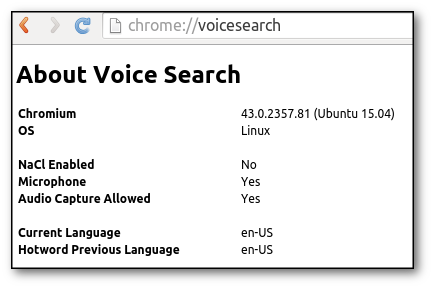
Without consent, Google’s code had downloaded a black box of code that – according to itself – had turned on the microphone and was actively listening to your room.
A brief explanation of the Open-source / Free-software philosophy is needed here. When you’re installing a version of GNU/Linux like Debian or Ubuntu onto a fresh computer, thousands of really smart people have analyzed every line of human-readable source code before that operating system was built into computer-executable binary code, to make it common and open knowledge what the machine actually does instead of trusting corporate statements on what it’s supposed to be doing. Therefore, you don’t install black boxes onto a Debian or Ubuntu system; you use software repositories that have gone through this source-code audit-then-build process. Maintainers of operating systems like Debian and Ubuntu use many so-called “upstreams” of source code to build the final product.
Chromium, the open-source version of Google Chrome, had abused its position as trusted upstream to insert lines of source code that bypassed this audit-then-build process, and which downloaded and installed a black box of unverifiable executable code directly onto computers, essentially rendering them compromised. We don’t know and can’t know what this black box does. But we see reports that the microphone has been activated, and that Chromium considers audio capture permitted.
This was supposedly to enable the “Ok, Google” behavior – that when you say certain words, a search function is activated. Certainly a useful feature. Certainly something that enables eavesdropping of every conversation in the entire room, too.
Obviously, your own computer isn’t the one to analyze the actual search command. Google’s servers do. Which means that your computer had been stealth configured to send what was being said in your room to somebody else, to a private company in another country, without your consent or knowledge, an audio transmission triggered by… an unknown and unverifiable set of conditions.
Google had two responses to this. The first was to introduce a practically-undocumented switch to opt out of this behavior, which is not a fix: the default install will still wiretap your room without your consent, unless you opt out, and more importantly, know that you need to opt out, which is nowhere a reasonable requirement. But the second was more of an official statement following technical discussions on Hacker News and other places. That official statement amounted to three parts (paraphrased, of course):
1) Yes, we’re downloading and installing a wiretapping black-box to your computer. But we’re not actually activating it. We did take advantage of our position as trusted upstream to stealth-insert code into open-source software that installed this black box onto millions of computers, but we would never abuse the same trust in the same way to insert code that activates the eavesdropping-blackbox we already downloaded and installed onto your computer without your consent or knowledge. You can look at the code as it looks right now to see that the code doesn’t do this right now.
2) Yes, Chromium is bypassing the entire source code auditing process by downloading a pre-built black box onto people’s computers. But that’s not something we care about, really. We’re concerned with building Google Chrome, the product from Google. As part of that, we provide the source code for others to package if they like. Anybody who uses our code for their own purpose takes responsibility for it. When this happens in a Debian installation, it is not Google Chrome’s behavior, this is Debian Chromium’s behavior. It’s Debian’s responsibility entirely.
3) Yes, we deliberately hid this listening module from the users, but that’s because we consider this behavior to be part of the basic Google Chrome experience. We don’t want to show all modules that we install ourselves.
If you think this is an excusable and responsible statement, raise your hand now.
Now, it should be noted that this was Chromium, the open-source version of Chrome. If somebody downloads the Google product Google Chrome, as in the prepackaged binary, you don’t even get a theoretical choice. You’re already downloading a black box from a vendor. In Google Chrome, this is all included from the start.
This episode highlights the need for hard, not soft, switches to all devices – webcams, microphones – that can be used for surveillance. A software on/off switch for a webcam is no longer enough, a hard shield in front of the lens is required. A software on/off switch for a microphone is no longer enough, a physical switch that breaks its electrical connection is required. That’s how you defend against this in depth.
Of course, people were quick to downplay the alarm. “It only listens when you say ‘Ok, Google’.” (Ok, so how does it know to start listening just before I’m about to say ‘Ok, Google?’) “It’s no big deal.” (A company stealth installs an audio listener that listens to every room in the world it can, and transmits audio data to the mothership when it encounters an unknown, possibly individually tailored, list of keywords – and it’s no big deal!?) “You can opt out. It’s in the Terms of Service.” (No. Just no. This is not something that is the slightest amount of permissible just because it’s hidden in legalese.) “It’s opt-in. It won’t really listen unless you check that box.” (Perhaps. We don’t know, Google just downloaded a black box onto my computer. And it may not be the same black box as was downloaded onto yours. )
Early last decade, privacy activists practically yelled and screamed that the NSA’s taps of various points of the Internet and telecom networks had the technical potential for enormous abuse against privacy. Everybody else dismissed those points as basically tinfoilhattery – until the Snowden files came out, and it was revealed that precisely everybody involved had abused their technical capability for invasion of privacy as far as was possible.
Perhaps it would be wise to not repeat that exact mistake. Nobody, and I really mean nobody, is to be trusted with a technical capability to listen to every room in the world, with listening profiles customizable at the identified-individual level, on the mere basis of “trust us”.
Privacy remains your own responsibility.
